
The Fascination of the Process
High-performance lasers are typically associated with precision manufacturing and
scientific research.
At EVOLAS, they are used in a fundamentally different way: to create visual art.
Within interactions between light, metal, and glass of extraordinary intensity,
a world of unexpected aesthetic depth begins to unfold.
Light Meets Matter
Material Transformation
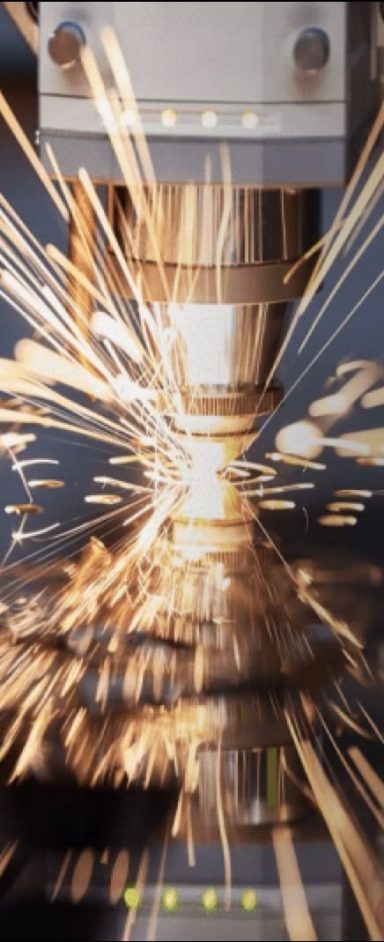
Laser light possesses exceptional properties, enabling it to accomplish things far beyond the capacities of ordinary light.
When a focused high-power laser pulse strikes a metal surface, a physical interaction of extreme intensity unfolds. Within fractions of a second, atomic bonds break under the immense energy of the laser light.
The material melts and vaporizes as a result of extreme energy input. It is then forcefully expelled from the interaction zone at high velocity and temperature.
Structures Within Glass
As the ejected material strikes a precisely positioned glass carrier, a powerful interaction unfolds. Hot metal droplets, vapor, and reactive by-products interact with the glass, creating solidified metal deposits, embedded particles, fine layers of reaction residues, and localized glass transformations.
Some structures remain on the surface, while others penetrate into the glass itself, forming intricate material constellations across multiple spatial layers.
At the same time, the interaction alters the glass body directly. Local fractures, internal reflections, translucent layers, and subtle structural transformations become part of the resulting material reality.
Emergence of Visual Reality
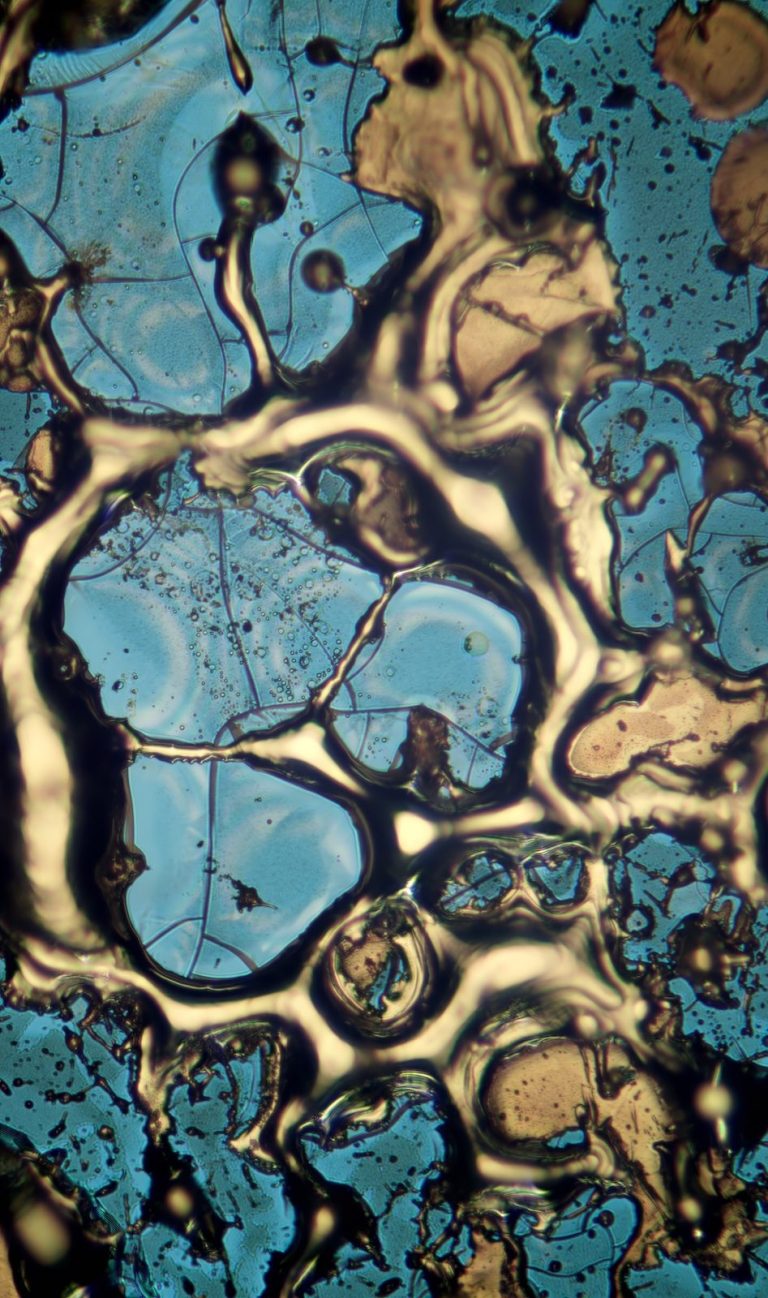
Together, these physical structures form intricate microscopic landscapes of matter and light.
Within these formations, metallic structures, reaction residues, glass transformations, and complex spatial relationships combine into a unique material reality.
This is the physical foundation from which EVOLAS artworks emerge.
Layers of Emergence
Successive Interactions
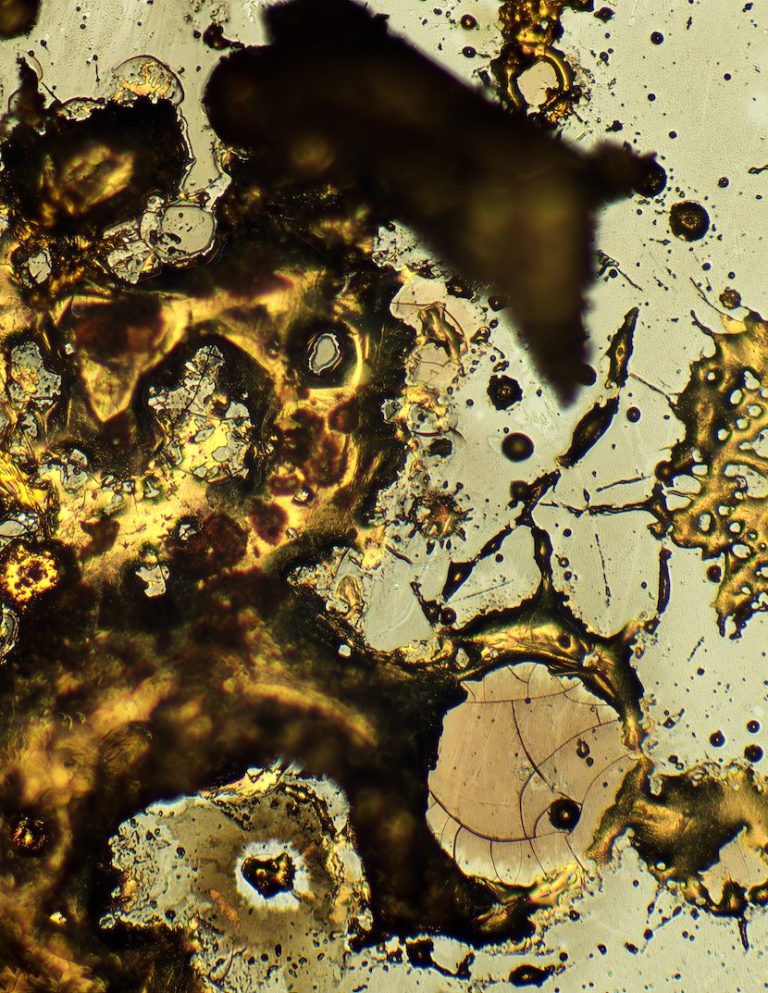
The complex material formations of an EVOLAS GLOBE typically emerge through multiple successive laser interactions.
Unfolding across different moments, positions, and physical conditions, every pulse leaves behind its own traces — material deposits, thermal effects, fractures, and structural transformations that accumulate over time within the same spatial domain.
Accumulation and Overlap
As these interactions overlap and build upon one another, increasingly dense and complex material formations begin to emerge.
Some structures remain clearly distinguishable, while others merge into layered constellations whose visual relationships can no longer be traced back to a single origin.
This gradual accumulation contributes significantly to the depth, richness, and complexity of the resulting material formations.
Material Memory
What ultimately emerges is not the trace of one moment, but the condensed material memory of many successive events.
Worlds Within Matter
Hidden Worlds
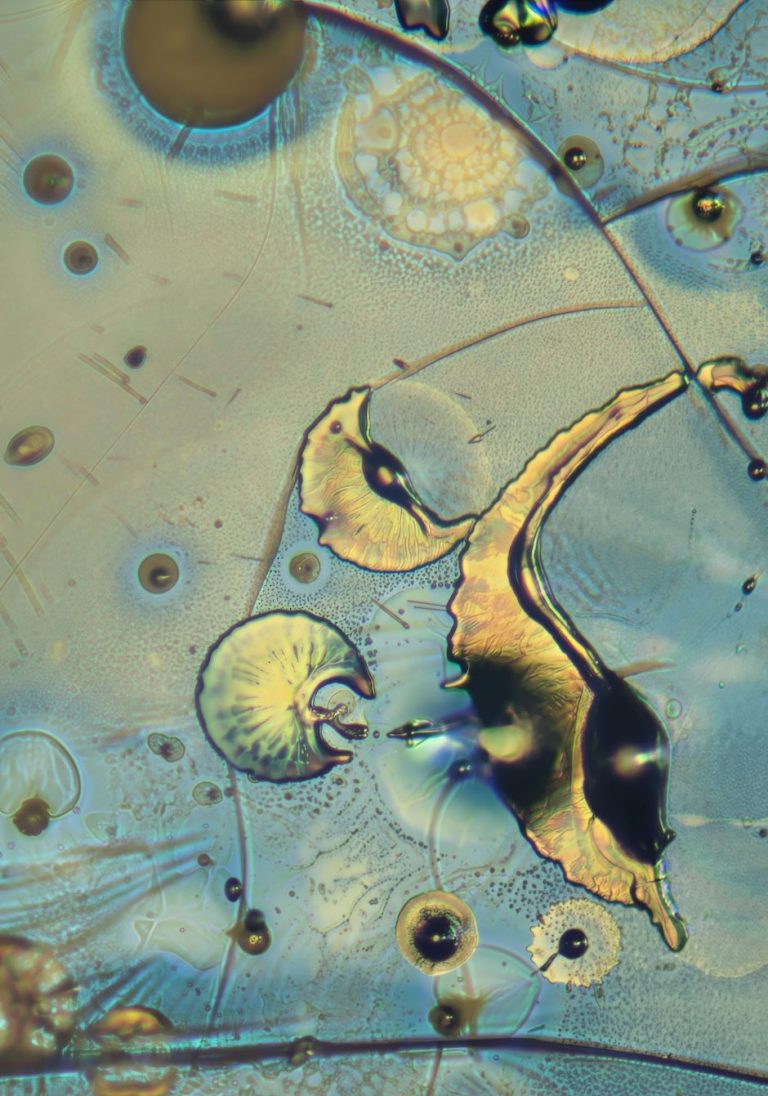
Within the resulting material formations, entire microcosms begin to reveal themselves.
Metallic filaments, translucent layers, embedded particles, fractures, reflections, and diffuse residues interact across multiple spatial depths, forming structures of remarkable visual complexity.
Even within very small regions, an extraordinary density of variation can emerge — from delicate textures and subtle color transitions to highly dynamic constellations shaped by accumulation, tension, and transformation.
Some areas appear almost architectural in character, while others evoke organic, atmospheric, or seemingly cosmic associations.
Perception Through Light
Light plays a decisive role in how these worlds become visible. Through reflection, refraction, transmission, and polarization, different layers and structures reveal entirely different visual qualities.
Perception is also shaped by scale. The same physical region can disclose entirely different visual worlds depending on magnification. Structures that appear subtle or peripheral at one level of observation may reveal unexpected complexity, tension, and visual character when explored more closely.
Transformation Through Scale
As illumination, color, magnification, and perspective change, the same physical structure can unfold into radically different aesthetic experiences — without any alteration of the material itself.
What becomes visible is not an imagined abstraction, but a real material world whose visual richness emerges directly from physical reality.
Chaos as Creative Force
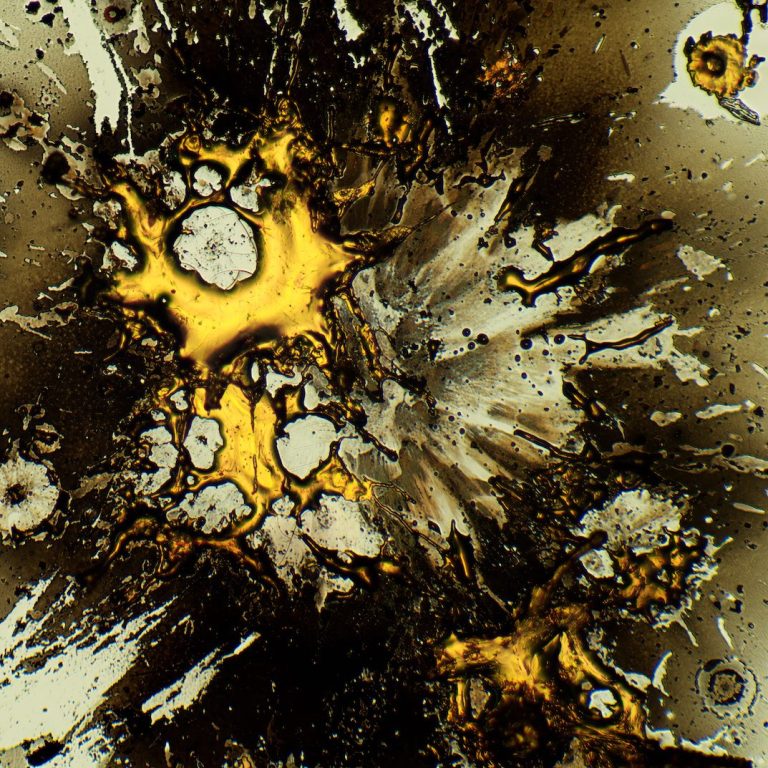
The entire process relies on an interplay of physical forces whose dynamics defy exact predictability — and this is precisely where its deep artistic potential lies.
Initiated by highly intense laser light, a series of thermo-chemical and mechanical transformations unfold simultaneously, giving rise to complex dynamics whose precise outcomes cannot be predicted or fully controlled.
In industrial and scientific environments, such unpredictability is minimized in pursuit of precision, consistency, and reproducibility.
At EVOLAS, however, these inevitable micro-chaotic phenomena are consciously embraced as essential sources of variation, depth, and aesthetic richness.
Rather than seeking complete control over the outcome, the artistic process deliberately embraces emergence, interaction, and unexpected visual development.
Through this tension between intention and unpredictability, the resulting formations achieve a level of dynamism, complexity, and visual richness that could never arise from fully controlled conditions.

Revealing the Invisible
Material Presence
The formations preserved on and within a glass carrier are already visible to the naked eye as traces, deposits, and material accumulations.
Their intricate structures, spatial depth, and visual character, however, only begin to reveal themselves through high-resolution microscopy.
Discovery and Interpretation
Exploring a GLOBE through microscopy is not an exercise in scientific documentation. It is an artistic journey of discovery, guided by visual sensitivity, intuition, and the search for compelling compositions.
Within dense material constellations, subtle regions of visual coherence begin to emerge — sometimes delicate and atmospheric, sometimes dramatic, dynamic, or unexpectedly figurative.
Perception Through Light and Scale
Magnification, illumination, focus, and perspective are not merely technical settings. They become instruments of artistic exploration and visual composition.
Through deliberate adjustments, the artist explores spatial relationships, establishes visual emphasis, and reveals qualities that might otherwise remain unnoticed. The underlying material remains unchanged, while its visual expression is consciously shaped.
From Material Reality to Visual Experience
Through this process of exploration and perceptual articulation, hidden material realities gradually unfold as visual experience.
From Physical Reality to Visual Art
Artistic Recognition
Within the vast material complexity of a GLOBE, only certain regions reveal the visual coherence, emotional resonance, and compositional presence required for artistic articulation.
The emergence of such motifs is not predetermined. They are discovered through sustained exploration, perceptual sensitivity, and artistic recognition.
Perceptual Articulation
What defines an EVOLAS artwork is not only the creation of its underlying material structure, but also the artistic recognition and deliberate development of a compelling visual composition within that reality.
Once a motif has been identified, the artist determines its final visual expression through decisions about framing, composition, spatial relationships, focus, light, and color.
These choices establish visual hierarchy, direct attention, and shape the emotional presence of the artwork. The physical structure remains unchanged, while its artistic expression becomes increasingly distinct.
Digital Clarity
Digital refinement serves perceptual clarity and precision. Fine details, subtle structures, and delicate light interactions may be enhanced in visibility, but no structural elements are added, removed, or transformed.
This refinement can reveal qualities that might otherwise remain barely perceptible due to the natural limitations of microscopy, without introducing anything that is not already present within the material reality of the GLOBE.
The final artwork therefore remains inseparably connected to its physical origin, while becoming a distinct visual composition shaped through artistic perception, interpretation, and deliberate creative decisions.
The EVOLAS GLOBE — Where Every Artwork Begins
Only when a glass carrier reveals structures of sufficient visual, spatial, and artistic coherence does it become an EVOLAS GLOBE.
“GLOBE” is an acronym for GLass Ornament BasE.
Each GLOBE serves as the physical origin and material foundation of multiple potential artworks, preserving the metallic formations, embedded structures, fractures, layers, and transformations created through the laser-initiated process.
Every EVOLAS artwork originates from a real microscopic motif physically present on and within the GLOBE’s glass corpus.
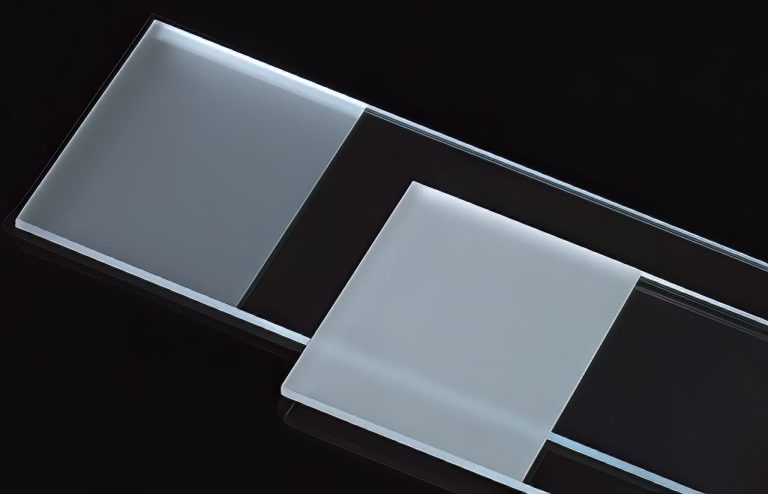
The artwork is neither digitally designed nor synthetically generated. It emerges through the exploration and artistic articulation of an existing material reality preserved within the GLOBE.
Each GLOBE possesses its own distinct visual character, material atmosphere, and internal world of potential motifs — forming a unique artistic microcosm from which multiple visual works may emerge over time.