
Where Light Ignites Matter
From Process to Art
When high-performance laser light interacts with metal and glass under extreme physical conditions, complex and unpredictable material structures emerge.
It is hard to imagine that such interactions could give rise to something defined by artistic beauty, aesthetics, and elegance.
Yet this is precisely where EVOLAS begins.
Each EVOLAS artwork originates from carefully orchestrated physical conditions, yet the emerging motifs defy any precise prediction or conscious design.
The conditions are set. The result is not.
Each motif preserves the physical traces of high-energy interactions between light, metal, and glass — captured once, never repeated.
The EVOLAS Principle
Condition Setting as Artistic Origin
Each EVOLAS work begins with a deliberate artistic act: defining the physical conditions under which high-energy laser light interacts with metal.
Artistic intention, physical emergence, and observation form an iterative process. What emerges from one interaction may inspire new decisions about the conditions of the next.
Reality Matters
Nothing is imagined. Nothing is simulated. Every structure originates from a real interaction of light, metal, and glass.
The resulting material reality extends beyond metallic deposits, encompassing reaction residues, translucent layers, and transformations within the glass itself.
Artistic Recognition
As physical structures emerge, artistic exploration takes on a new dimension. Rather than directly composing the structures, the artist engages with the complex material reality that has developed.
Through exploration, coherent visual constellations are recognized within a dense material landscape. These are selected, interpreted, and articulated as visual works.
Perceptual Transformation
Through magnification, light, color, focus, and perspective — and in some cases polarization — the same physical structure can reveal fundamentally different visual qualities.
These artistic decisions shape its visual expression without altering the underlying material reality.
Authorship
Authorship, in this context, does not reside in direct composition, but in the deliberate creation and refinement of physical conditions and in the recognition, selection, and artistic articulation of what emerges.
Each EVOLAS artwork is therefore both a physical reality and an artistic interpretation of that reality.
Authentic in origin. Discovered through observation. Unique by nature.
The Name EVOLAS
The name EVOLAS combines two roots: the Latin verb evolare — “to fly away, to soar, to rush out” — inspired by the high-velocity ejection of hot metal, and the initial letters of LASER, symbolizing the technology at the core of the process.
Together, they reflect the convergence of scientific precision and artistic exploration.
EVOLAS stands for evolution through creation — the emergence of form from energy, and the discovery of meaning within it.
The material result remains unchanged, while the artistic act shifts toward identifying and articulating emergent structures — including their perceptual transformation through light, color, and perspective.
The technological foundations of EVOLAS trace back to Werner’s early research at the IFSW (Institut für Strahlwerkzeuge) of the University of Stuttgart, where he investigated laser–material interactions in the context of single-pulse drilling.
About the Artist
Many years later, this scientific foundation evolved into EVOLAS — not as a continuation of research, but as a fundamentally different act: the artistic engagement with emergent material structures.
Werner holds a degree in mechanical engineering (Dipl.-Ing.) and has spent over three decades working in industrial and digital environments.
EVOLAS brings these domains together — not by combining them, but by transforming one into the other.
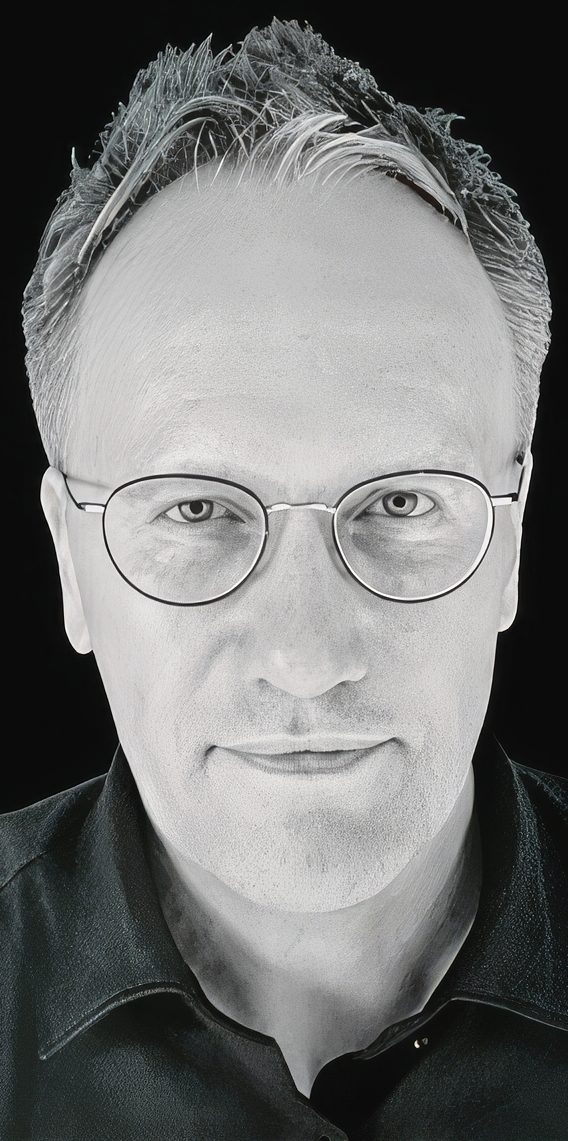
Werner is the artist behind EVOLAS — an artistic practice that transforms high-performance industrial laser processes into visual art.
His work is grounded in a distinct artistic approach: the deliberate definition of physical conditions — materials, sequence, and process parameters — from which complex structures emerge on and within glass.
What follows is not intervention, but exploration, recognition, interpretation, and — above all — artistic expression through composition, focus, light, and color.
An Unexpected Origin
Some art starts in a studio.
Ours starts here.
EVOLAS has its roots in a world shaped by manufacturing and research: high-performance industrial laser technology.
For decades, industrial lasers have been used to cut, weld, and drill metals with exceptional precision and efficiency — especially where conventional manufacturing methods reach their limits.
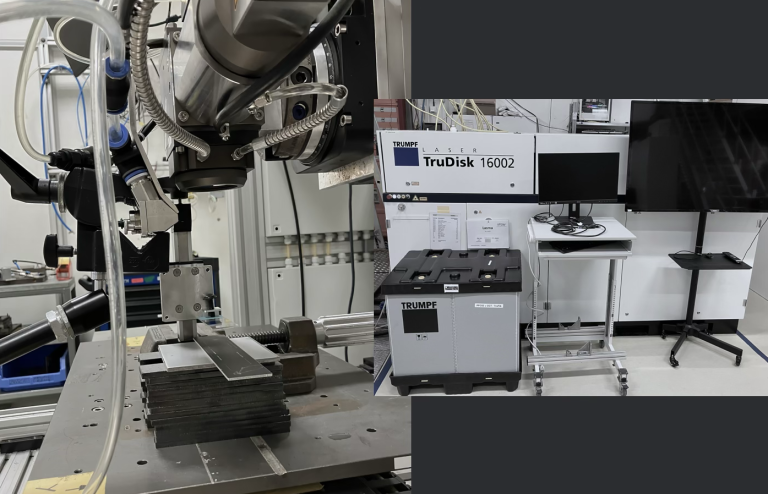
At EVOLAS, the same technology is given an entirely different purpose. Its extraordinary capabilities become an instrument for artistic creation.
The result is art with a technological origin — not inspired by technology, not illustrating it, but made possible by it.
Technology is part of every EVOLAS artwork’s DNA.